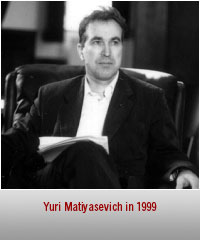
 It was 1970 and Matiyasevich was 22 years old. In his own black and white 8mm home movies, we can see him typing away on a portable manual typewriter. The films also contain one of Matiyasevich's first talks about the solution to H10. He has generously made the footage available to this film. It was 1970 and Matiyasevich was 22 years old. In his own black and white 8mm home movies, we can see him typing away on a portable manual typewriter. The films also contain one of Matiyasevich's first talks about the solution to H10. He has generously made the footage available to this film.
Constance Reid and Martin Davis describe how John McCarthy's notes taken at a lecture in Novosibirsk about Matiyasevich's result made their way to the United States, to Julia and to Martin. Julia's emotional reaction is conveyed by readings from a letter she wrote Matiyasevich upon learning that H10 had been solved.
Without ever having met, Matiyasevich and Robinson forged a unique relationship during a period when U.S.-Soviet relations were strained. The correspondence between Robinson and Matiyasevich that flourished tells of the excitement that each of them felt at having contributed to an achievement as momentous as the solution of a Hilbert problem. They went on to work on other problems by mail. Their letters reveal the creation of a strong emotional bond. Matiyasevich is often overcome by emotion as he reveals that Julia Robinson became the most important person in his life.
He also describes how difficult it was for him to develop and sustain a lengthy correspondence with Julia Robinson and other American colleagues when Soviet censors were monitoring his mail.
Robinson and Matiyasevich finally managed to meet at a conference in Bucharest, Romania in 1971, and Matiyasevich took his home movie camera. The footage he shot there contains the only known filmed images of Julia and Raphael Robinson, and of Alfred Tarski.
 Recognition of Julia Robinson's contributions to mathematics finally resulted in an appointment to the mathematics department at the University of California. In 1976 she was elected to the National Academy of Sciences. It was the first of many honors she amassed, including presidency of the American Mathematical Society (AMS), election to the AAAS, and a MacArthur award. Recognition of Julia Robinson's contributions to mathematics finally resulted in an appointment to the mathematics department at the University of California. In 1976 she was elected to the National Academy of Sciences. It was the first of many honors she amassed, including presidency of the American Mathematical Society (AMS), election to the AAAS, and a MacArthur award.
Julia Robinson quickly became the most prominent woman in American mathematics. It was a role she had not sought: "All this attention is gratifying but also embarrassing. What I really am is a mathematician. Rather than being remembered as the first woman this or that. I would prefer to be remembered, as a mathematician should, simply for theorems I have proved and the problems I have solved."
Constance Reid's relationship with Julia Robinson is another theme that unfolds as the film progresses. By the end of the story it is clear that Reid's career as a highly renowned biographer of mathematicians is a part of Julia Robinson's legacy. This is pointedly illustrated by Reid's account of Julia Robinson's bout with leukemia and death in 1985, and of the circumstances leading to Julia's autobiography.
Evaluations of Julia Robinson's life and mathematical achievements from several people in the film are interwoven as a sequence of anecdotes and telling statements. Lenore Blum, Martin Davis, Anita and Solomon Feferman, Steve Givant, Yuri Matiyasevich, Bjorn Poonen, and Dana Scott are key commentators.
Robinson's role in breaking down the academic barriers in mathematics faced by American women into the 1970s and beyond is addressed by Lenore Blum, a founder of American Women in Mathematics. It also reverberates in the presence of a young woman named Anna Salamon, who was filmed in 1999 because she had been awarded the annual Julia Robinson Prize in Mathematics at San Diego High School.
Among the women inspired by Julia Robinson who appear in the film is Kirsten Eisenträger, a mathematician who has pursued research into a generation of problems based on H10.
|