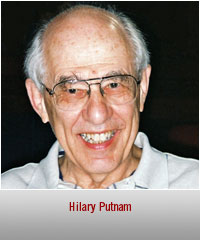
 Davis, Putnam, and Robinson concluded that the solution to H10 required a proof that listable sets and Diophantine sets were the same. They made some progress, but finding a proof eluded them. Every year Julia made a wish that it did not matter to her who solved the problem, but that she wanted to know the answer before dying. Davis, Putnam, and Robinson concluded that the solution to H10 required a proof that listable sets and Diophantine sets were the same. They made some progress, but finding a proof eluded them. Every year Julia made a wish that it did not matter to her who solved the problem, but that she wanted to know the answer before dying.
For a time, Julia Robinson's political beliefs took over her life. She was involved in the fight over the controversial loyalty oath imposed on faculty members at the University of California at Berkeley. And in the mid-1950s she committed herself entirely to working on Adlai Stevenson's unsuccessful presidential campaigns.
Following the disappointments of politics, Julia returned to mathematics. Martin Davis and Hilary Putnam tell the story of how she joined them in the famous Davis, Putnam, Robinson paper of 1961. But H10 was stubborn. Martin Davis went so far as to joke at one of his presentations that he believed a young Russian who was yet to be born would eventually solve the problem.
During this time Julia continued to suffer the lingering effects of her childhood illnesses. "By the time the joint paper was published (November 1961) my heart had broken down just as the doctor in San Diego had predicted; and I had to have surgery to clear out the mitral valve. One month after the operation I bought my first bicycle," she tells us.
Yuri Matiyasevich first heard about Hilbert's tenth problem at the end of 1965 when he was a sophomore at the Department of Mathematics and Mechanics at Leningrad State University, and he too become captivated with the challenge of searching for a solution. He read Julia Robinson's 1952 paper, but was unable to make any meaningful progress.
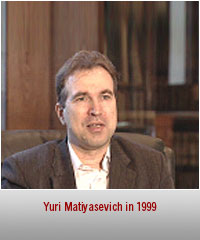 In an interview filmed in Gent in 1999, Matiyasevich described his early involvement in H10, and his tenacity in sticking with the problem in the face of disapproval and ridicule by peers and teachers. "One professor began to laugh at me. Each time we met he would ask: 'Have you proved the unsolvability of Hilbert's tenth problem? Not yet? But then you will not be able to graduate from the university.'" In an interview filmed in Gent in 1999, Matiyasevich described his early involvement in H10, and his tenacity in sticking with the problem in the face of disapproval and ridicule by peers and teachers. "One professor began to laugh at me. Each time we met he would ask: 'Have you proved the unsolvability of Hilbert's tenth problem? Not yet? But then you will not be able to graduate from the university.'"
"Then one day in the autumn of 1969, some of my colleagues told me: 'rush to the library. In the recent issue of the Proceedings of the American Mathematical Society there is a new paper by Julia Robinson!' But I was firm in putting Hilbert's tenth problem aside. I told myself, 'It is nice that Julia Robinson goes on with the problem, but I cannot waste my time on it any longer.' So I did not rush to the library. But somewhere in the mathematical heavens there must be a god or goddess of mathematics who would not let me fail to read Julia Robinson's new paper. Because of my early publications on the subject, I was considered a specialist on the tenth problem, and so the paper was sent to me to review. Thus I was forced to read Julia Robinson's paper, and Hilbert's tenth problem captured me again."
In the interview, Matiyasevich revealed the process of discovery that followed. "On the morning of January 3, I believed I had a solution of Hilbert's tenth problem, but by the end of that day I had discovered a flaw in my work. But the next morning I managed to mend the construction. I wrote out a detailed proof without finding any mistake and asked Sergei Maslov and Vladimir Lifshits to check, but not to say anything about it to anyone else. I had planned to spend the winter holidays with my bride at a ski camp, so I left Leningrad before I got the verdict from Maslov and Lifshits. For a fortnight I was skiing, simplifying my proof, and writing the paper."
Matiyasevich's proof involved the use of Fibonacci numbers, an idea that is relatively easy to illustrate. The film includes a sequence explaining the Fibonacci numbers and their history, as well as an aside about Fibonacci and the reproduction of rabbits. The DVD of the film features the classic 1996 film by Beau Janzen, Fibonacci and the Golden Mean, as an extra feature.
As Matiyasevich himself declares, his solution depended crucially on Julia Robinson's earlier work. She had set up the final piece of the problem by solving a number of other things first and by presenting a hypothesis that he followed. "I tried to convey the impact of Julia Robinson's paper on my work by a rather poetic Russian word, which seems to have no direct counterpart in English; roughly it means, 'as if blown by the wind,'" Matiyasevich wrote.
|